Plugin library for analytic fitting. More...

Classes | |
| class | ddastoys::Configuration |
| Manage fit configuration information. More... | |
| struct | ddastoys::analyticfit::GslFitParameters |
| Data passed around the fitting subsystem to Jacobian and function evaluators. More... | |
| double | ddastoys::analyticfit::logistic (double A, double k, double x1, double x) |
| Evaluate a logistic function for the specified parameters and point. More... | |
| double | ddastoys::analyticfit::decay (double A, double k, double x1, double x) |
| Evaluate an exponential decay for the specific parameters and point. More... | |
| double | ddastoys::analyticfit::switchOn (double x1, double x) |
| Logistic switch to turn on a function evaluation at a given point. More... | |
| double | ddastoys::analyticfit::singlePulse (double A1, double k1, double k2, double x1, double C, double x) |
| Evaluate the single pulse fit function at a given point. More... | |
| double | ddastoys::analyticfit::doublePulse (double A1, double k1, double k2, double x1, double A2, double k3, double k4, double x2, double C, double x) |
| Evaluate the double pulse fit function at a given point. More... | |
| double | ddastoys::analyticfit::pulseAmplitude (double A, double k1, double k2, double x0) |
| Calculate the pulse amplitude corrected for the ballistic deficit imposed by the exponential decay. More... | |
| double | ddastoys::analyticfit::chiSquare1 (double A1, double k1, double k2, double x1, double C, const std::vector< uint16_t > &trace, int low=0, int high=-1) |
| Computes the chi-square goodness-of-fit for a specific parameterization of a single pulse canonical form with respect to a trace. More... | |
| double | ddastoys::analyticfit::chiSquare1 (double A1, double k1, double k2, double x1, double C, const std::vector< std::pair< uint16_t, uint16_t > > &points) |
| Computes the chi-square goodness-of-fit for a specific parameterization of a single pulse canonical form with respect to a trace. More... | |
| double | ddastoys::analyticfit::chiSquare2 (double A1, double k1, double k2, double x1, double A2, double k3, double k4, double x2, double C, const std::vector< uint16_t > &trace, int low=0, int high=-1) |
| Computes the chi-square goodness of a specific parameterization of a double pulse canonical form with respect to a trace. More... | |
| double | ddastoys::analyticfit::chiSquare2 (double A1, double k1, double k2, double x1, double A2, double k3, double k4, double x2, double C, const std::vector< std::pair< uint16_t, uint16_t > > &points) |
| Computes the chi-square goodness of a specific parameterization of a double pulse canonical form with respect to a trace. More... | |
| void | ddastoys::analyticfit::writeTrace (const char *filename, const char *title, const std::vector< uint16_t > &trace) |
| Write a single trace to a file. More... | |
| void | ddastoys::analyticfit::writeTrace2 (const char *filename, const char *title, const std::vector< uint16_t > &trace1, const std::vector< uint16_t > &trace2) |
| Write two traces to a file. More... | |
| void | ddastoys::analyticfit::lmfit1 (fit1Info *pResult, std::vector< uint16_t > &trace, const std::pair< unsigned, unsigned > &limits, uint16_t saturation=0xffff) |
| Driver for the GSL LM fitter for single pulses. More... | |
| void | ddastoys::analyticfit::lmfit2 (fit2Info *pResult, std::vector< uint16_t > &trace, const std::pair< unsigned, unsigned > &limits, fit1Info *pSinglePulseFit=nullptr, uint16_t saturation=0xffff) |
| Driver for the GSL LM fitter for double pulses. More... | |
| void | ddastoys::analyticfit::lmfit2fixedT (fit2Info *pResult, std::vector< uint16_t > &trace, const std::pair< unsigned, unsigned > &limits, fit1Info *pSinglePulseFit=nullptr, uint16_t saturation=0xffff) |
| Driver for the GSL LM fitter for double pulses, constraining the two timing parameters (rise time and fall time) to be the same for both pulses. More... | |
Detailed Description
Plugin library for analytic fitting.
Function Documentation
◆ chiSquare1() [1/2]
| double ddastoys::analyticfit::chiSquare1 | ( | double | A1, |
| double | k1, | ||
| double | k2, | ||
| double | x1, | ||
| double | C, | ||
| const std::vector< std::pair< uint16_t, uint16_t > > & | points | ||
| ) |
Computes the chi-square goodness-of-fit for a specific parameterization of a single pulse canonical form with respect to a trace.
- Parameters
-
A1 Amplitude of pulse k1 Steepness of pulse rise. k2 Decay time of pulse fall. x1 Position of the pulse. C Constant offset of the trace. points Set of (x, y) data points which contribute to the total chi-square value
- Returns
- The chi-square goodness-of-fit statistic.
Neyman's chi-square. The chi-square value is calculated from a passed set of (x, y) points.
◆ chiSquare1() [2/2]
| double ddastoys::analyticfit::chiSquare1 | ( | double | A1, |
| double | k1, | ||
| double | k2, | ||
| double | x1, | ||
| double | C, | ||
| const std::vector< uint16_t > & | trace, | ||
| int | low = 0, |
||
| int | high = -1 |
||
| ) |
Computes the chi-square goodness-of-fit for a specific parameterization of a single pulse canonical form with respect to a trace.
- Parameters
-
A1 Amplitude of pulse k1 Steepness of pulse rise. k2 Decay time of pulse fall. x1 Position of the pulse. C Constant offset of the trace. trace Trace to compute the chi-square value with respect to. low,high Region of interest over which to compute the chi-square value.
- Note
- high = -1 will set the high limit to the last sample in the trace.
- Returns
- The chi-square goodness-of-fit statistic.
Neyman's chi-square. The chi-square value is calculated based on the passed limits low, high.
◆ chiSquare2() [1/2]
| double ddastoys::analyticfit::chiSquare2 | ( | double | A1, |
| double | k1, | ||
| double | k2, | ||
| double | x1, | ||
| double | A2, | ||
| double | k3, | ||
| double | k4, | ||
| double | x2, | ||
| double | C, | ||
| const std::vector< std::pair< uint16_t, uint16_t > > & | points | ||
| ) |
Computes the chi-square goodness of a specific parameterization of a double pulse canonical form with respect to a trace.
- Parameters
-
A1 Amplitude of the first pulse. k1 Steepness of first pulse rise. k2 Decay time of the first pulse. x1 Position of the first pulse. A2 Amplitude of the second pulse. k3 Steepness of second pulse rise. k4 Decay time of second pulse. x2 Position of second pulse. C Constant offset the pulses sit on. points Set of x, y data points which contribute to the total chi-square value
- Returns
- The chi-square goodness-of-fit statistic.
Neyman's chi-square. The chi-square value is calculated from a passed set of (x, y) points.
◆ chiSquare2() [2/2]
| double ddastoys::analyticfit::chiSquare2 | ( | double | A1, |
| double | k1, | ||
| double | k2, | ||
| double | x1, | ||
| double | A2, | ||
| double | k3, | ||
| double | k4, | ||
| double | x2, | ||
| double | C, | ||
| const std::vector< uint16_t > & | trace, | ||
| int | low = 0, |
||
| int | high = -1 |
||
| ) |
Computes the chi-square goodness of a specific parameterization of a double pulse canonical form with respect to a trace.
- Parameters
-
A1 Amplitude of the first pulse. k1 Steepness of first pulse rise. k2 Decay time of the first pulse. x1 Position of the first pulse. A2 Amplitude of the second pulse. k3 Steepness of second pulse rise. k4 Decay time of second pulse. x2 Position of second pulse. C Constant offset the pulses sit on. trace Trace to compute the chisquare with respect to. low,high Region of interest over which to compute the chi-square value.
- Note
- high = -1 will set the high limit to the last sample in the trace.
- Returns
- The chi-square goodness-of-fit statistic.
Neyman's chi-square. The chi-square values is calculated based on the passed limits low, high.
◆ decay()
| double ddastoys::analyticfit::decay | ( | double | A, |
| double | k, | ||
| double | x1, | ||
| double | x | ||
| ) |
Evaluate an exponential decay for the specific parameters and point.
- Parameters
-
A Amplitude of the signal k Decay constant of the signal. x1 Position of the pulse. x Where to evaluate the signal.
- Returns
- Function value at x.
Signals from detectors usually have a falling shape that approximates an exponential. This function evaluates this decay at some point.
◆ doublePulse()
| double ddastoys::analyticfit::doublePulse | ( | double | A1, |
| double | k1, | ||
| double | k2, | ||
| double | x1, | ||
| double | A2, | ||
| double | k3, | ||
| double | k4, | ||
| double | x2, | ||
| double | C, | ||
| double | x | ||
| ) |
Evaluate the double pulse fit function at a given point.
- Parameters
-
A1 Amplitude of the first pulse. k1 Steepness of first pulse rise. k2 Decay time of the first pulse. x1 Position of the first pulse. A2 Amplitude of the second pulse. k3 Steepness of second pulse rise. k4 Decay time of second pulse. x2 Position of second pulse. C Constant offset the pulses sit on. x Position at which to evaluate the pulse.
- Returns
- Double pulse function evaluated at x.
Evaluate the canonical form of a double pulse. This is done by summing two single pulses. The constant term is thrown into the first pulse. The second pulse gets a constant term of 0.
◆ lmfit1()
| void ddastoys::analyticfit::lmfit1 | ( | fit1Info * | pResult, |
| std::vector< uint16_t > & | trace, | ||
| const std::pair< unsigned, unsigned > & | limits, | ||
| uint16_t | saturation = 0xffff |
||
| ) |
Driver for the GSL LM fitter for single pulses.
- Parameters
-
pResult Struct that will get the results of the fit. trace Vector of trace points. limits Limits of the trace over which to conduct the fit. saturation Value at which the ADC is saturated (points at or above this value are removed from the fit.)
Implements GSL's Levenburg-Marquardt fitter to determine best-fit parameters by chi-square minimization.
◆ lmfit2()
| void ddastoys::analyticfit::lmfit2 | ( | fit2Info * | pResult, |
| std::vector< uint16_t > & | trace, | ||
| const std::pair< unsigned, unsigned > & | limits, | ||
| fit1Info * | pSinglePulseFit = nullptr, |
||
| uint16_t | saturation = 0xffff |
||
| ) |
Driver for the GSL LM fitter for double pulses.
- Parameters
-
pResult Results will be stored here. trace References the trace to fit. limits The limits of the trace that can be fit. pSinglePulseFit The fit for a single pulse, used to seed initial guesses if present. Otherwise a single pulse fit is done for that. saturation ADC saturation value. Points with values at or above this value are removed from the fit.
Implements GSL's Levenburg-Marquardt fitter to determine best-fit parameters by chi-square minimization.
◆ lmfit2fixedT()
| void ddastoys::analyticfit::lmfit2fixedT | ( | fit2Info * | pResult, |
| std::vector< uint16_t > & | trace, | ||
| const std::pair< unsigned, unsigned > & | limits, | ||
| fit1Info * | pSinglePulseFit = nullptr, |
||
| uint16_t | saturation = 0xffff |
||
| ) |
Driver for the GSL LM fitter for double pulses, constraining the two timing parameters (rise time and fall time) to be the same for both pulses.
- Parameters
-
pResult Results will be stored here. trace References the trace to fit. limits The limits of the trace that can be fit. pSinglePulseFit The fit for a single pulse, used to seed initial uesses if present. Otherwise a single pulse fit is done for that. saturation ADC saturation value. Points with values at or above this value are removed from the fit.
Implements GSL's Levenburg-Marquardt fitter to determine best-fit parameters by chi-square minimization.
◆ logistic()
| double ddastoys::analyticfit::logistic | ( | double | A, |
| double | k, | ||
| double | x1, | ||
| double | x | ||
| ) |
Evaluate a logistic function for the specified parameters and point.
- Parameters
-
A Amplitude of the signal. k Steepness of the signal (related to the rise time). x1 Mid-point of the rise of the logistic. x Location at which to evaluate the function.
- Returns
- Function value at x.
A logistic function is a function with a sigmoidal shape. We use it to fit the rising edge of signals from DDAS digitizes. See e.g. https://en.wikipedia.org/wiki/Logistic_function for a discussion of this function.
◆ pulseAmplitude()
| double ddastoys::analyticfit::pulseAmplitude | ( | double | A, |
| double | k1, | ||
| double | k2, | ||
| double | x0 | ||
| ) |
Calculate the pulse amplitude corrected for the ballistic deficit imposed by the exponential decay.
- Parameters
-
A The scaling term of the pulse. k1 The steepness term of the logistic. k2 The fall time term of the decay. x0 The position of the pulse.
- Returns
- The corrected amplitude of the fitted pulse.
- Return values
-
-1 If 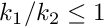 .
.
The A1 term in a pulse fit is not actually the "true" pulse amplitude. The effect of the exponential decay is already important causing A1 to over-estimate the amplitude.
This function computes the "true" amplitude of a pulse given its parameters. This is done by noting that the deriviative of the pulse has a zero at:

We plug that position back into the pulse to get the amplitude.
◆ singlePulse()
| double ddastoys::analyticfit::singlePulse | ( | double | A1, |
| double | k1, | ||
| double | k2, | ||
| double | x1, | ||
| double | C, | ||
| double | x | ||
| ) |
Evaluate the single pulse fit function at a given point.
- Parameters
-
A1 Pulse amplitiude. k1 Logistic rise steepness. k2 Exponential decay time constant. x1 Logistic position. C Constant offset. x Position at which to evaluate the function.
- Returns
- double Single pulse function evaluated at x.
Evaluate the value of a single pulse in accordance with our canonical functional form. The form is a logistic rise with an exponential decay that sits on top of a constant offset.
◆ switchOn()
| double ddastoys::analyticfit::switchOn | ( | double | x1, |
| double | x | ||
| ) |
Logistic switch to turn on a function evaluation at a given point.
- Parameters
-
x1 Switch on point. The switch is "on" for values greater than x1. x Point in space at which to evaluate the switch.
- Returns
- The switch value: very nearly 0.0 left of x1 and very nearly 1.0 to the right of x1.
Provides a multipier that can be used to turn on a function at a point in space. This is provided for GPUs that may want to define functions with conditional chunks without the associated flow control divergence conditionals would require. This is implemented as a very steep logistic with rise centered at the point in question.
◆ writeTrace()
| void ddastoys::analyticfit::writeTrace | ( | const char * | filename, |
| const char * | title, | ||
| const std::vector< uint16_t > & | trace | ||
| ) |
Write a single trace to a file.
- Parameters
-
filename Where to write. title Title string. trace The trace data.
◆ writeTrace2()
| void ddastoys::analyticfit::writeTrace2 | ( | const char * | filename, |
| const char * | title, | ||
| const std::vector< uint16_t > & | t1, | ||
| const std::vector< uint16_t > & | t2 | ||
| ) |
Write two traces to a file.
- Parameters
-
filename Where to write. title Title string. t1 The first trace. t2 The second trace.
- Note
- The traces must be the same length.