CUDA-aware fit engine for analytic double pulse fits. More...
#include <jacobian_analytic.h>
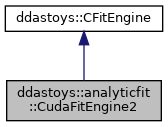
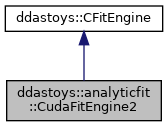
Public Member Functions | |
| CudaFitEngine2 (std::vector< std::pair< uint16_t, uint16_t >> &data) | |
| Constructor. More... | |
| ~CudaFitEngine2 () | |
| Destructor. More... | |
| virtual void | jacobian (const gsl_vector *p, gsl_matrix *J) |
| Marshall the parameter and call the jacobian2 kernel. Then pull the Jacobian matrix out of the GPU and marshall it back into the GSL Jacobian matrix. More... | |
| virtual void | residuals (const gsl_vector *p, gsl_vector *r) |
| Fire off the kernel to compute the pointwise residuals. More... | |
 Public Member Functions inherited from ddastoys::CFitEngine Public Member Functions inherited from ddastoys::CFitEngine | |
| CFitEngine (std::vector< std::pair< uint16_t, uint16_t >> &data) | |
| Constructor. More... | |
| virtual | ~CFitEngine () |
| Destructor. | |
Additional Inherited Members | |
| Protected Attributes inherited from ddastoys::CFitEngine | |
| std::vector< uint16_t > | x |
| Trace x coordinate vector. | |
| std::vector< uint16_t > | y |
| Trace y coordinate vector. | |
Detailed Description
CUDA-aware fit engine for analytic double pulse fits.
The concept is that each GSL lmfitter can supply a pair of methods: One that computes a vector of residuals and one that computes a Jacobian matrix of partial derivatives. At the implementation level we have two types of fits we need done: Single pulse fits and double pulse fits (the engines with names ending in 1 or 2). For each fit type we have two fit engines: 1) Serial computation (the engines with names starting with Serial) 2) GPU accelerated (the engines with names starting with Cuda).
Finally a fit factory can generate the appropriate fit engine as desired by the actual fit.
- Todo:
- (ASC 10/30/23): Manages some device pointers. Not copyable, and most likely is not ever copied. But we can make it safe.
Constructor & Destructor Documentation
◆ CudaFitEngine2()
| ddastoys::analyticfit::CudaFitEngine2::CudaFitEngine2 | ( | std::vector< std::pair< uint16_t, uint16_t >> & | data | ) |
Constructor.
- Parameters
-
data The trace data in x/y pairs.
Allocate the GPU resources:
- Trace x array
- Trace y array.
- Residual array.
- Jacobian vector (m_npts * 9)
- Move the trace into the GPU where it stays for all iterations of the fit.
◆ ~CudaFitEngine2()
| ddastoys::analyticfit::CudaFitEngine2::~CudaFitEngine2 | ( | ) |
Destructor.
Just frees the device blocks.
Member Function Documentation
◆ jacobian()
|
virtual |
Marshall the parameter and call the jacobian2 kernel. Then pull the Jacobian matrix out of the GPU and marshall it back into the GSL Jacobian matrix.
- Parameters
-
p Parameter vector from GSL. J Jacobian matrix to output.
- Note
- We organize the computing into 32 thread blocks because there are 32 thread per warp.
Implements ddastoys::CFitEngine.
◆ residuals()
|
virtual |
Fire off the kernel to compute the pointwise residuals.
- Parameters
-
p Fit parameters. r Residual vector.
Implements ddastoys::CFitEngine.
The documentation for this class was generated from the following files: